
Can You Really Get Spanish Residency Through a Language School? (Yes, Here's How)
This question shows up in every Spain forum, usually followed by ten contradictory answers. Some say it's a well-known "loophole." Others say it's a myth and you'll get nothing. Neither is quite right. Here's the precise, honest answer — including the one legal distinction almost nobody explains properly.
Key takeaways
- Spanish law separates "estancia" (stay) from "residencia" (residence) — a language-course visa technically grants a stay authorization, not the same legal category as a long-term residence permit.
- In practice, though, you get everything that matters day to day: a TIE card, an NIE, legal empadronamiento in Valencia, a bank account, and the right to live here full-time.
- What you don't get automatically: permanent residency, an unlimited stay, or a direct route to a work permit.
- For most people asking this question, what they actually want — a legal, full-time life in Valencia, right now — is exactly what this route delivers.
Let's answer it directly: yes, enrolling in a language school in Spain gets you a real, legal immigration status — but the word "residency" is doing more work in that question than most people realize, and getting the terminology right is the difference between understanding your actual situation and getting a nasty surprise at renewal time.
Spanish immigration law draws a real distinction between an estancia (a stay) and a residencia (a residence permit). A language-course student visa is technically the former: an autorización de estancia por estudios. That's not a technicality designed to disappoint you — it's the actual legal category, and understanding it precisely is what separates a confident, well-planned move to Valencia from a confused one.
What this guide covers
Estancia vs residencia: the distinction that matters
In everyday English, "residency" just means "the legal right to live somewhere." In Spanish immigration law, it's more specific. An estancia is an authorization to stay in Spain for a defined purpose — study, in this case — typically for up to a year at a time, renewable under certain conditions. A residencia, by contrast, is a residence permit tied to a different purpose (work, passive income, family ties) that's built, from day one, on a track toward long-term or permanent status.
A language-course visa falls into the first category. If your course runs longer than six months, you'll still get a physical TIE card — the same type of document a "real" residency holder carries — but the underlying legal authorization behind it is a stay for studies, not a residence permit in the strict technical sense. Courses at a private language academy, specifically, are also capped in how long they can be renewed for, unlike university-level study or the residence-based visas.
What you actually get, living in Valencia
Here's where the honest answer gets genuinely good news, because in practical, everyday terms, a language-course student visa gets you a real life in Valencia — not a watered-down version of one.
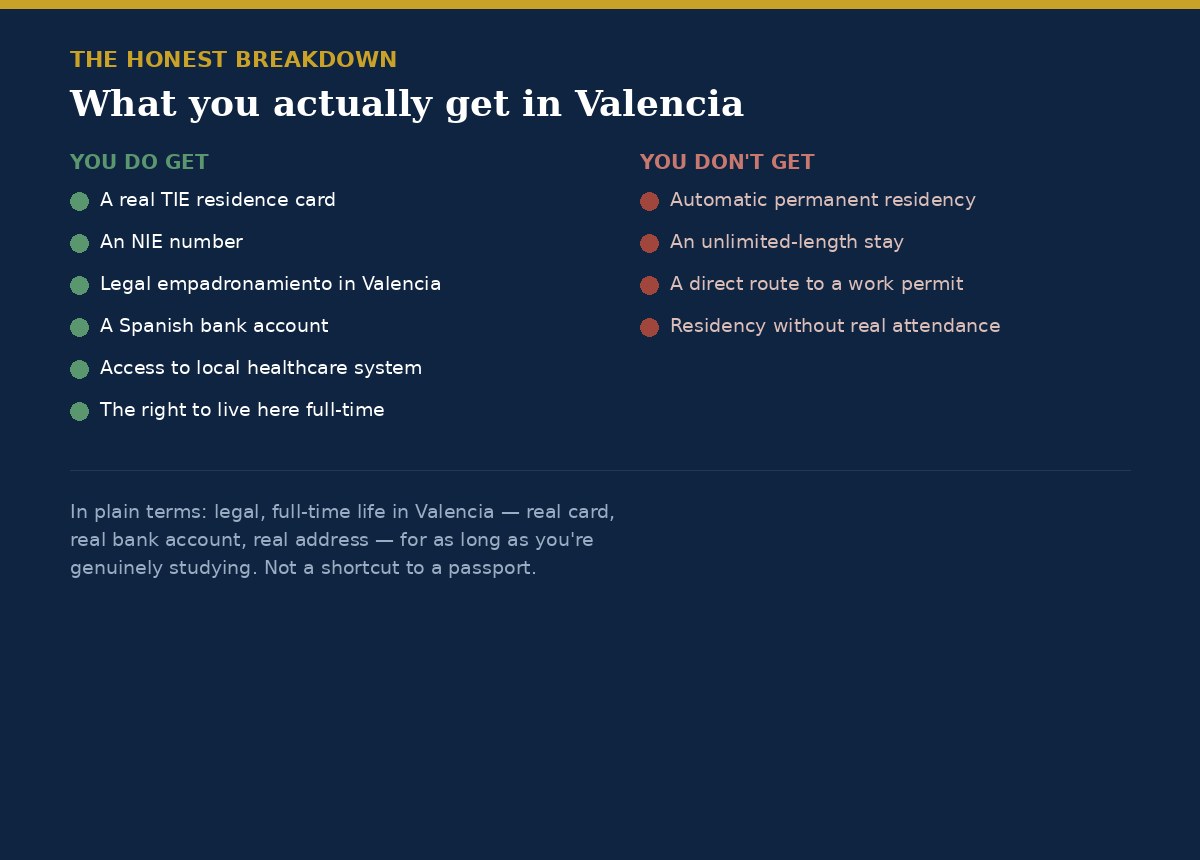
- A real TIE card. If your course runs over six months, you'll apply for this at the Valencia Foreigners' Office, and it becomes your everyday ID in Spain.
- An NIE number. Already printed on your visa when you arrive — the number you'll use for absolutely everything administrative.
- Legal empadronamiento in Valencia. You register your actual address at the town hall, the same as any other resident of the city.
- A Spanish bank account. Once you have your NIE and address, opening one is completely routine.
- Access to the local healthcare system, alongside your required private insurance.
- The right to live here full-time — not a tourist stay, not 90-day visa runs, but a genuine, documented, legal life in the city.
If what you actually wanted when you typed this question into a search bar was "can I legally live in Valencia, with a real address, a real bank account and a real ID card, without needing €2,400 a month in passive income" — the honest answer is yes, absolutely, and thousands of people are doing exactly that right now.
What you don't get
Equally honestly, here's what this route doesn't hand you:
- Automatic permanent residency. The five-year path that the Non-Lucrative and Digital Nomad visas offer doesn't apply the same way to a language-course stay.
- An unlimited stay. Language-course authorizations are capped in how many times they can be renewed — this isn't designed to be an indefinite arrangement.
- A direct route to a work permit. Under current rules, a language-course stay can't be converted directly into a work-and-residence permit the way higher-education study can.
- Residency without genuine attendance. This is tied to real, documented study. Schools track attendance, and significant abandonment can be reported to the authorities — it's not a formality you can skip.
None of this makes the route "fake" or a loophole about to close. It's a real, legal, well-established category doing exactly what it's designed to do — it's just not designed to be a backdoor to permanent status, and being upfront about that is the whole point of this article.
Why forums get this so confused
Spend an hour reading Spain-related threads and you'll see the same argument on repeat: someone insists "you can totally get residency through a language school," someone else replies "that's not real residency, don't fall for it," and both are half-right, talking past each other because they're using "residency" to mean two different things.
The first person usually means: I got a TIE card, an NIE, a bank account, and I legally live here full-time. True. The second person usually means: this isn't the same legal category as a residence permit that leads to permanent status in five years. Also true. Once you separate those two meanings — which this article has just done — the argument mostly dissolves. You're not being scammed by the first camp or gaslit by the second; you're just watching two people argue past a definitional gap that almost nobody bothers to close.
How this compares to "real" residency routes
| Language-course student visa | Non-Lucrative / Digital Nomad Visa | |
|---|---|---|
| Legal category | Estancia (stay) | Residencia (residence permit) |
| Monthly income needed | ~€600 | ~€2,400–2,849 |
| TIE card issued | Yes, if over 6 months | Yes |
| Path to permanent residency | Not automatic, capped renewals | Yes, after 5 years |
| Day-to-day legal life in Valencia | Full — NIE, bank account, empadronamiento | Full — same practical rights |
Notice the last row: day to day, the two experiences look remarkably similar. The real difference is what happens at year five, not what happens this year. For a deeper, income-focused comparison of all three routes, see our guide to Student Visa vs Non-Lucrative vs Digital Nomad Visa, or the full landscape in how to move to Spain legally.
Who this is realistically right for
Read plainly, this route fits you well if:
- You want to live in Valencia legally and full-time this year, not once your finances reach a different threshold.
- You're genuinely willing to enroll in and attend a real course — this isn't paperwork you can fake your way through.
- You're comfortable with a defined, renewable-but-capped timeline rather than an open-ended one.
- You see this as a real chapter — maybe the first one — rather than a permanent, final answer to "how do I live in Spain forever."
It fits less well if your only goal is permanent residency as fast as legally possible with no interest in actually studying — in that case, the Non-Lucrative or Digital Nomad routes, if you qualify financially, are built for that specific goal from the start.
See what this looks like for your situation
Tell us your goals and timeline, and we'll walk you through exactly what a language-course stay in Valencia would mean for you — honestly, including its limits. Free, no obligation.
Get honest guidance →How to actually do it in Valencia
- Choose a genuine, accredited course. An intensive Spanish course is the format most students use, as it meets the weekly-hours requirement for the visa.
- Get your acceptance letter and enroll properly — this becomes the anchor document for your application.
- Apply at your local Spanish consulate, with proof of funds (~€600/month), insurance, and — for longer stays — background and medical checks. Our step-by-step process guide walks through every phase.
- Arrive in Valencia and complete your empadronamiento and TIE application if your stay is over six months — full details in our Valencia-specific visa guide.
- Actually attend. This is what keeps the whole arrangement legitimate and renewable — and, honestly, it's also how you get real value out of the months you're spending here.
- Decide what's next, from inside Spain. Whether that's heading home with real Spanish and real experience, extending your studies, or building toward a different long-term route — you'll be deciding that as someone who's actually lived here, not someone guessing from abroad.
Frequently asked questions
Can you get Spanish residency through a language school?
You get a legal stay authorization (estancia por estudios), not a residence permit (residencia) in the strict legal sense. In practice, this gives you a TIE card, an NIE, legal address registration and the right to live in Spain full-time — but it doesn't automatically lead to permanent residency the way work-based or passive-income visas do.
What's the difference between "estancia" and "residencia" in Spanish law?
An estancia is an authorization to stay for a defined purpose like study, typically renewable but not automatically building toward permanent status. A residencia is a residence permit tied to work, passive income or family ties, built from the start on a track toward long-term or permanent residency.
Do I get a TIE card on a language-course student visa?
Yes, if your course runs longer than six months. You'll apply for it after arriving in Valencia, and it functions as your everyday photo ID in Spain.
Can a language-course student visa lead to permanent residency?
Not automatically. Language-course stays are capped in renewal length and don't convert directly into a work-and-residence permit under current rules. Higher-education study has more flexibility toward that path.
Is this a loophole that could close?
No — it's a genuine, long-established legal category (the student visa), not an exploit of a technicality. It's designed for real study, and using it for that purpose is exactly how it's meant to work.
Can I open a bank account and rent an apartment on this visa?
Yes. Once you have your NIE and are registered in Valencia, opening a bank account and signing a lease are both routine.
Why do people online disagree about whether this "counts" as residency?
Because they're using the word differently — some mean the everyday, practical experience of legally living in Spain full-time (which this route does provide), others mean the specific legal category of a residence permit with a path to permanent status (which it technically isn't).
How long can I actually stay this way?
You can renew for as long as you're genuinely enrolled and progressing, including passing an official DELE or SIELE exam when required, but total renewable length for language-academy stays is capped rather than indefinite.
Do I need to actually attend classes, or is this just paperwork?
You need to genuinely attend. Schools monitor attendance, and significant course abandonment can be reported to immigration authorities, which can jeopardize your legal status.
Is this a good option if my real goal is permanent residency?
Only as a starting point, not a direct route. If permanent residency as quickly as possible is your primary goal and you already meet the financial thresholds, the Non-Lucrative or Digital Nomad visas are built specifically for that track.
Ready for a real, honest start in Valencia?
Fill in the form and we'll help you choose a qualifying course and understand exactly what your legal status will look like — free and with no obligation.
Get started →