
How to Move to Spain Legally: Every Real Pathway, Compared
"How do I actually move to Spain?" is one of the most-searched questions about the country — and one of the most poorly answered. Property-investment visas closed in 2025. Passive-income visas need thousands a month. The route almost nobody talks about is often the fastest and most accessible one available right now: the student visa.
Key takeaways
- Spain's investment-based "Golden Visa" was abolished on 3 April 2025 and no longer accepts applications — many guides online are now outdated.
- The two most-discussed alternatives, the Non-Lucrative Visa (~€2,400/month) and the Digital Nomad Visa (~€2,849/month), require serious ongoing income most people simply don't have.
- The student visa requires proving only around €600 a month — a fraction of the alternatives — making it the most financially accessible legal route into Spain for most non-EU citizens.
- It's a genuinely legal, well-established pathway: you live in Spain full-time, can often work part-time, and can build from there — it just requires enrolling in a real course, like learning Spanish in Valencia.
Type "how to move to Spain legally" into Google and you'll get a flood of contradictory advice, much of it written before April 2025 — before Spain abolished the property-investment "Golden Visa" that used to anchor half the articles on this topic. What's left is a genuinely confusing landscape: several visa types, each with its own income thresholds, work rules and paperwork, and very little honest comparison between them.
This guide fixes that. We'll walk through every real legal pathway available to non-EU citizens today, compare them honestly side by side, and then focus on the one route that quietly solves the problem for more people than any other: the student visa. If your ultimate destination is Valencia specifically, this pairs with our Valencia-specific visa guide and our complete Spanish student visa guide.
What this guide covers
- What happened to the Golden Visa
- Every legal route, at a glance
- The number that matters most: income thresholds
- The Non-Lucrative Visa, in depth
- The Digital Nomad Visa, in depth
- Work visas and family reunification
- Why the student visa is the most accessible route
- Country-specific notes: US, Canada, UK, Australia
- Common myths about moving to Spain
- How to actually start
- FAQ
What happened to the Golden Visa (and why it matters to you)
If you've read anything about moving to Spain, you've probably come across the "Golden Visa" — the route that granted residency to non-EU citizens who bought property worth €500,000 or more. It doesn't exist anymore. Spain's Organic Law 1/2025 abolished the investor residency route entirely, effective 3 April 2025. Applications submitted before that date are still being processed under the old rules, but no new ones are accepted.
This matters because a huge amount of content online still treats the Golden Visa as a live option. If a guide you're reading doesn't mention its closure, it's outdated — and possibly wrong about other details too. Buying property in Spain is still completely open to non-EU citizens; it simply no longer comes bundled with a residence permit.
Every legal route into Spain, at a glance
With the Golden Visa gone, here's the real landscape for non-EU citizens who want to live in Spain legally:
| Route | Who it's for | Monthly income needed | Can you work? |
|---|---|---|---|
| Golden Visa | Property investors | Abolished 3 April 2025 — no longer available | |
| Non-Lucrative Visa | Retirees, passive income | ~€2,400 | No — not even remote foreign work |
| Digital Nomad Visa | Remote workers paid abroad | ~€2,849 | Yes, for your foreign employer/clients only |
| Work / Highly Qualified Visa | People with a Spanish job offer | N/A — tied to salary | Yes, for the sponsoring employer |
| Entrepreneur / Start-up Visa | Founders of innovative businesses | Varies by project | Yes, in your own venture |
| Student Visa | Anyone enrolled in a qualifying course | ~€600 | Limited, up to 30h/week (rules vary by course type) |
| Family Reunification | Family of Spanish/EU residents | Varies | Depends on permit granted |
Look at that income column again. Every route except the student visa asks for financial firepower that most people — especially anyone under 40, early in their career, or without significant savings — simply doesn't have yet.
The number that matters most: income thresholds compared
Here's the same comparison visually, because the gap is the whole story:
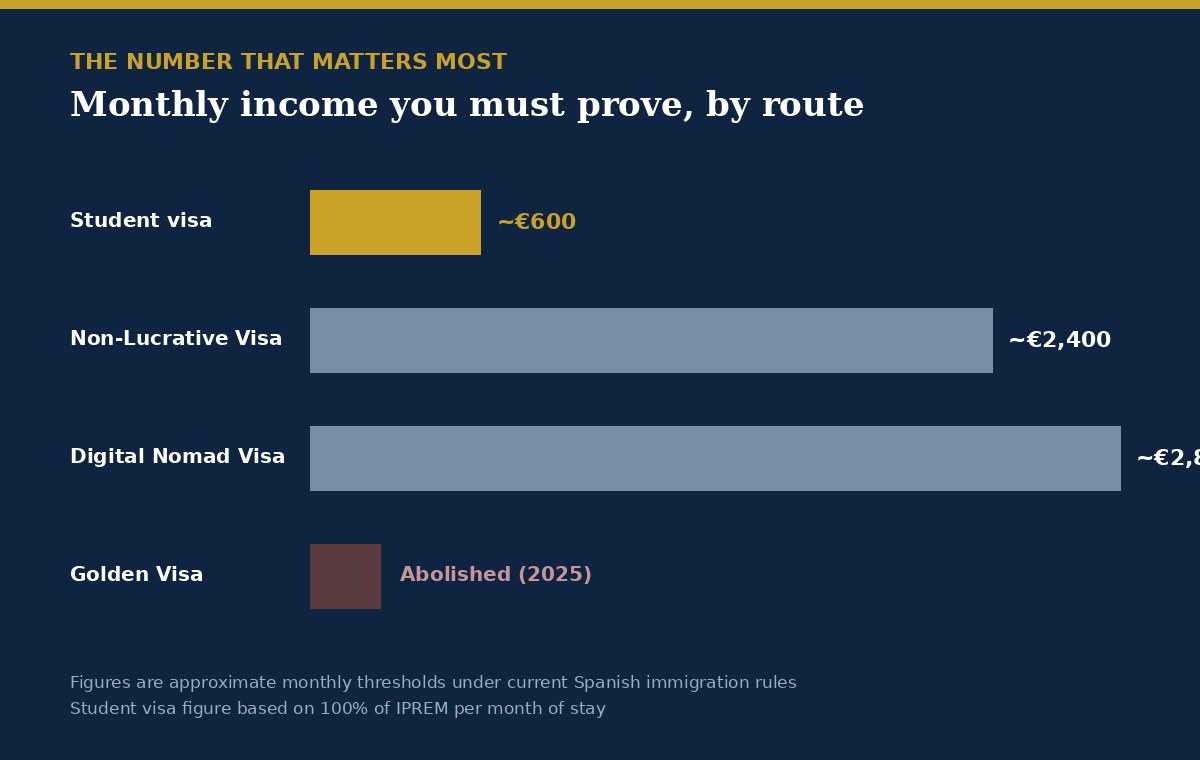
The Non-Lucrative Visa and Digital Nomad Visa are excellent options — if you already have a remote job paying well above average, or enough savings and passive income to comfortably clear €2,400–2,849 a month indefinitely. For a lot of people dreaming of Spain — students, early-career professionals, people between jobs, people wanting to test the waters before a bigger move — that bar is simply out of reach right now.
The student visa asks for around €600 a month — close to a quarter of the other options. That's not a loophole; it's simply a different, well-established legal category with its own honest purpose: full-time study. But it's also a real, legal way to live in Spain today, at an income level far more people can actually meet.
The Non-Lucrative Visa, in depth
Designed for people who want to live in Spain without working there at all — classically, retirees. You must prove passive income or savings of roughly €2,400 a month (~€28,800 a year) for a single applicant, plus around €600 a month per dependent, along with private health insurance and a clean criminal record. It's granted for one year, renewable for two-year periods, and can lead to permanent residency after five years.
The catch that surprises people: this visa prohibits all work, including remote work for a foreign employer. If you have any active income at all, this isn't your route — that's what the Digital Nomad Visa is for.
The Digital Nomad Visa, in depth
Built for people who work remotely for companies or clients based outside Spain. You'll typically need to show income around €2,849 a month (200% of Spain's minimum wage), with extra amounts for a spouse or dependents. Many holders also benefit from a favorable flat tax rate under Spain's "Beckham Law" regime.
The requirement that trips people up: consulates want detailed proof of a genuine remote arrangement — a proper letter confirming your employer is based outside Spain, not a vague freelance claim. If your income comes from a stable remote job or well-established freelance client base well above that threshold, this can be an excellent route. If you're just starting out professionally, it's often out of reach.
Work visas and family reunification
If a Spanish company offers you a job and sponsors your application, this is the most direct route to working residency — but it depends entirely on finding an employer willing to sponsor a non-EU hire, which is genuinely difficult without an in-country network or highly specialized skills.
If you have a spouse, partner or close family member who is a Spanish or EU resident, you may qualify to join them. Requirements vary by relationship and the sponsor's own status.
Both are legitimate, but neither is something you can simply decide to pursue tomorrow — one requires an employer to choose you from abroad, the other requires a qualifying relationship you may not have.
Why the student visa is the most accessible route for most people
Put the honest picture together and a pattern emerges. The Non-Lucrative and Digital Nomad visas need serious, stable income most people don't yet have. Work visas need an employer to take a chance on you from abroad. Family reunification needs a qualifying relationship. The student visa needs none of that — just enrollment in a genuine, full-time course.
Here's what makes it worth taking seriously as a real pathway, not just a technicality:
- The lowest financial bar by far. Around €600 a month versus €2,400–2,849 for the main alternatives.
- No employer, no sponsor, no qualifying relationship needed. You control the entire process yourself.
- You can often work part-time alongside your studies, up to 30 hours a week, which softens the financial pressure further — see our full guide to working on a student visa.
- It's completely legal, ordinary, and well-established — thousands of people use it every year, and it comes with none of the grey-area risk of overstaying a tourist visa.
- It buys you time on the ground to build the local network, language skills and life experience that make a longer-term route — a job offer, a stronger remote income, a relationship — much more achievable from inside Spain than from abroad.
And the course itself doesn't have to feel like a hurdle. Learning Spanish is genuinely useful wherever your life in Spain leads next, and doing it through an intensive course in Valencia — one of the country's most livable, affordable cities — turns the "paperwork requirement" into months you'll actually be glad you spent.
See if the student route works for you
Tell us your situation and goals. We'll help you understand whether the student visa is your fastest legal path to Spain, and match you with a qualifying course in Valencia — free, no obligation.
Get free guidance →Country-specific notes: US, Canada, UK, Australia
The visa categories above apply the same way regardless of your passport — but a few practical details vary by nationality, and they're worth knowing before you plan.
Moving to Spain from the United States
US citizens can visit Spain visa-free for up to 90 days, but any of the routes above require applying at a Spanish consulate in the US. The student visa consular fee for US applicants tends to run higher than for many other nationalities (often in the $140–160 range), and background-check processing — the FBI fingerprint check many long-stay applications require — can take several weeks, so build that into your timeline early.
Moving to Spain from Canada
Canadians also enjoy 90-day visa-free entry and follow the same consulate-based process for longer stays. Fees are generally moderate (often around $83 for a student visa), and Canada's own criminal background check process is usually more predictable in timing than the US equivalent — still, start it early.
Moving to Spain from the UK
Since Brexit, UK citizens are treated as non-EU nationals for all Spanish immigration purposes — the 90-day free travel window and all the visa routes above apply exactly as they do to Americans or Canadians. Some routes apply UK-specific reciprocity fee rates, which can be higher than the standard rate, so check current consulate fees rather than assuming the general figure.
Moving to Spain from Australia
Australians follow the same 90-day visa-free allowance and the same consulate process for anything longer. As with other reciprocity-rate countries, confirm current fees directly with your nearest Spanish consulate, since they can differ from the general figures quoted for other nationalities.
Common myths about moving to Spain
- "I can just buy a house and get residency." Not anymore — the property-investment Golden Visa closed in April 2025. You can still buy property freely, but it no longer grants a residence permit.
- "I can live there on a tourist visa if I just leave every 90 days." This is a common but risky misconception. Schengen rules limit non-EU stays to 90 days within any 180-day period across the whole Schengen area, not per country — border authorities do track this, and violations can affect future entry.
- "You need to be rich to move to Spain legally." Only true for the Non-Lucrative and Digital Nomad routes. The student visa's threshold is a fraction of those.
- "The student visa is only for 18-year-olds." Not true — there's no upper age limit, and plenty of career-changers, remote workers between jobs, and retirees-in-waiting use it as a genuine, legal way to live in Spain.
- "Studying Spanish doesn't lead anywhere." It won't automatically convert into permanent residency, and language-course stays are capped — but it's real, legal time in the country, real language skills, and a real foundation to build the next step from inside Spain rather than from abroad.
How to actually start
- Be honest about your numbers. If you can comfortably prove €2,400+ a month in passive or remote income, look seriously at the Non-Lucrative or Digital Nomad visa. If not, the student visa is very likely your fastest legal way in.
- Choose a genuine, qualifying course. It needs to be full-time and at an accredited school — an intensive Spanish course is the format most students use.
- Get your acceptance letter. This becomes the anchor document for your whole application.
- Gather your personal documents — passport, insurance, financial proof, and (for longer stays) background and medical checks.
- Apply at your local Spanish consulate, ideally two to three months before you want to start.
- Land in Spain and build from there — whether that means finishing your course and heading home with real Spanish skills, or using the time to explore what comes next.
Ready to explore your legal route to Spain?
We help international students choose a qualifying Spanish course in Valencia, connect with a school that prepares their visa paperwork, and understand every phase of the process.
Start your journey →Frequently asked questions
How do I move to Spain legally as a non-EU citizen?
You need a visa matched to your situation: the Non-Lucrative Visa for passive income, the Digital Nomad Visa for remote work, a work visa with an employer sponsor, family reunification, or a student visa if you enroll in a qualifying course. There's no single universal "move to Spain" visa — the right one depends on your income source and goals.
Is the Golden Visa still available?
No. Spain abolished the investor Golden Visa on 3 April 2025 under Organic Law 1/2025. Property purchases no longer grant residency rights.
What's the cheapest legal way to move to Spain?
In terms of the income you need to prove, the student visa is by far the most accessible, requiring roughly €600 a month compared to around €2,400–2,849 a month for the Non-Lucrative or Digital Nomad visas.
Can I move to Spain without a job offer?
Yes. The Non-Lucrative Visa, Digital Nomad Visa and student visa don't require a Spanish job offer — they're based on passive income, remote income, or enrollment in a course, respectively.
Can I just stay in Spain as a tourist and renew every 90 days?
No. The 90-day allowance applies across the entire Schengen area within any 180-day period, not per country, and it isn't renewable by leaving and re-entering. Overstaying or gaming this can jeopardize future entry.
Is the student visa a real, legal way to live in Spain?
Yes, completely. It requires genuine enrollment in a qualifying full-time course, but it's a well-established, legal immigration category used by thousands of people every year.
Can I work while on a student visa?
Generally yes, up to 30 hours a week, though the process differs depending on whether you're in higher education or a language academy. See our dedicated guide on working with a student visa in Spain.
How much money do I need for the Non-Lucrative Visa?
Around €2,400 a month (about €28,800 a year) for a single applicant, plus roughly €600 a month for each additional dependent, and you cannot work at all on this visa, even remotely for a foreign employer.
How much money do I need for the Digital Nomad Visa?
Around €2,849 a month, based on 200% of Spain's minimum wage, plus additional amounts for a spouse or dependents. It requires stable, verifiable remote income from outside Spain.
Does the student visa lead to permanent residency?
Not automatically. A language-course stay doesn't convert directly into a work-and-residence permit under current rules, and renewals are capped. Higher-education programs have more flexibility. Treat the student visa as a legal way to live in Spain now and build from, not a guaranteed pipeline to permanent status.
What's the fastest legal way to move to Spain?
For most people without an existing high remote income, a Spanish job offer, or a qualifying family relationship, the student visa is typically the fastest realistic route, since it depends mainly on enrolling in a course and meeting a modest financial threshold.
Do I need to speak Spanish to move there?
No — none of these visa routes require Spanish language proficiency to apply. If you choose the student visa route via a Spanish course, you'll simply learn as you go.
Does moving to Spain from the US, Canada, UK or Australia work differently?
The visa categories and core process are the same. What differs is mainly the consulate fee and, for some nationalities, reciprocity-based fee rates — always confirm current costs with your local Spanish consulate.
Can retirees move to Spain legally?
Yes, typically via the Non-Lucrative Visa if they have sufficient passive income (pensions, investments) around €2,400 a month, since this visa doesn't require working in Spain.
What happens after my student visa expires?
You can renew if you continue studying and meet the requirements (including, for language courses, showing progress via an official exam like the DELE), return home with your new skills, or use the time you've spent in Spain to pursue a different long-term route, such as a job offer or a stronger remote income.
Let's find your legal way to Spain
Fill in the form and we'll help you understand your options and, if the student route fits, match you with a qualifying Spanish course in Valencia — free and with no obligation.
Get started →