
Can I Work With a Student Visa in Spain?
Short answer: Yes, you may be eligible to work up to 30 hours a week.
Longer answer: If you're enrolled in a qualifying 20-hour-per-week Spanish course and obtain a Spanish student visa, you may be eligible to work up to 30 hours per week under current Spanish immigration rules. Here's what's true, what's a myth, and how to do it properly.
Key takeaways
- Non-EU student visa holders can work up to 30 hours a week, as long as it doesn't interfere with classes.
- Higher-education students (university, master's, FP) get this right automatically, built into their visa/TIE.
- Language-academy students can also work, but usually need a separate work authorization, normally applied for by the employer once you've been hired.
- Work is limited to the province where you live, and only the main visa holder is authorized — not accompanying family.
It's one of the most-asked — and most-misreported — questions from students planning a move to Spain. Type it into Google and you'll find contradictory answers: some sites say all student visa holders get automatic work rights, others say you always need special authorization. Both are half right, and getting it wrong can genuinely put your legal status at risk.
Here's the clear version, based on the current immigration rules under Royal Decree 1155/2024, which reshaped Spain's student visa system. If you haven't yet applied for your visa, this pairs well with our complete Spanish student visa guide and our guide to the student visa to study Spanish in Valencia.
What this guide covers
- The short answer
- The two tracks: higher education vs language courses
- If you're on a higher-education visa
- If you're on a language-course visa
- The rules that apply to everyone
- Internships: an easier alternative
- What kind of jobs are realistic
- Common mistakes that jeopardize your visa
- Can your family work too?
- FAQ
The short answer
Yes — a Spanish student visa allows you to work, up to 30 hours per week, as long as it doesn't clash with your class schedule and your studies stay the priority. This limit applies across the board, whether you're at university or at a private language academy.
But how you get there is where the confusion starts. Some students get this right built into their visa automatically. Others have to actively apply for it once they've found a job. Confuse the two and you risk working illegally without realizing it — which can jeopardize your visa renewal.
The two tracks: higher education vs language courses
This is the single most important distinction, and it's the one most guides gloss over. Since the 2025 reform, Spain treats two types of students very differently:
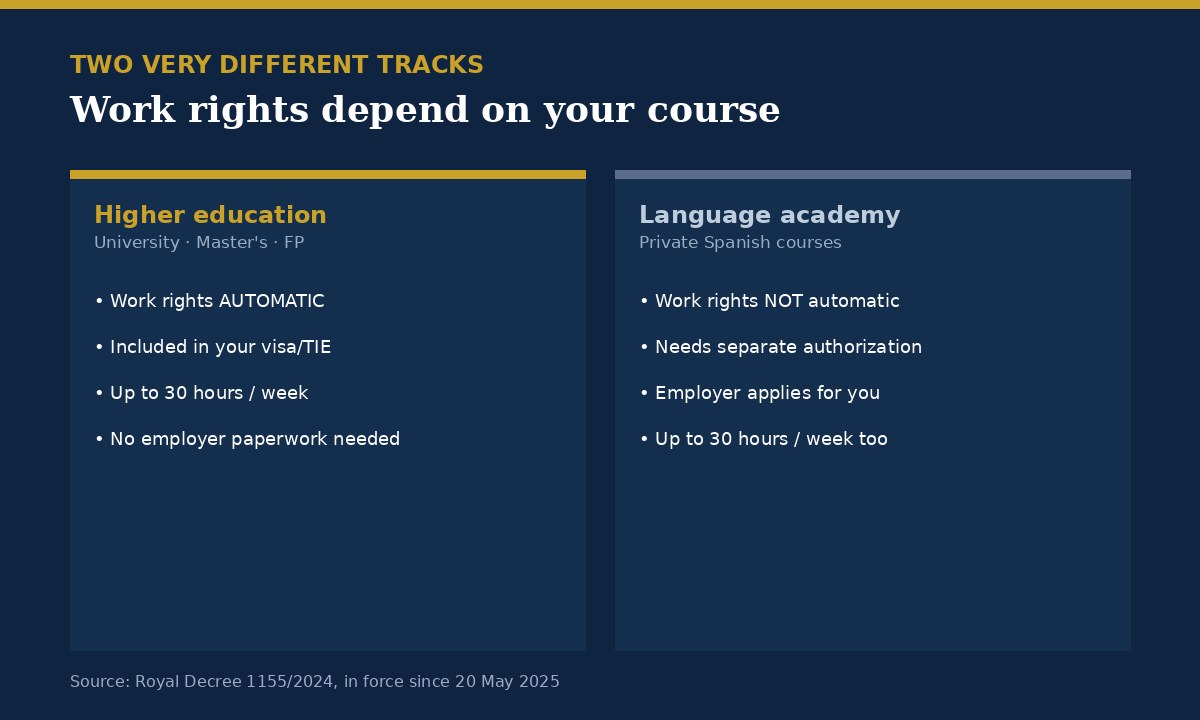
| Higher education | Language academy | |
|---|---|---|
| Includes | University degrees, master's, PhDs, vocational training (FP), university-run language programs | Private Spanish language schools and academies |
| Work authorization | Automatic, built into the visa/TIE | Not automatic — must be requested separately |
| Who applies | Nobody needs to — it's already granted | Usually the employer, once you're hired |
| Weekly limit | 30 hours | 30 hours |
If you're coming to Valencia for an intensive Spanish course at a private academy — the most common route for language learners — you fall into the second column. That doesn't mean you can't work; it just means there's an extra step.
If you're on a higher-education visa
If your student visa is based on a university degree, a master's, a PhD, or vocational training (FP), you're in the easier position. Since the 2025 reform, your work authorization is included automatically in your student visa and TIE card. There's no separate application, no employer paperwork, no waiting on immigration — you can start a compatible job as soon as you find one, employed or self-employed, up to 30 hours a week.
If you're on a language-course visa
This is the track most Spanish-language students are on, and it's where the rules genuinely differ. A student visa for a private language academy does not come with automatic work rights. To work legally, you generally need to go through this process:
- Arrive and get your TIE. You need a valid student visa and TIE card before any work authorization can be processed.
- Find an employer willing to sponsor you. Not every business wants to handle the paperwork, so look for employers used to hiring international students — language schools, hospitality, and international-facing businesses are often a good starting point.
- The employer applies for your work authorization. They file the request with Spanish immigration on your behalf; you don't file it yourself.
- Wait for approval. Until it's granted, you're not authorized to work — even if you already have a verbal job offer.
- Start working, within the limits. Up to 30 hours a week, only in the province where you live, and never overlapping your class schedule.
The rules that apply to everyone
Whichever track you're on, these conditions are non-negotiable:
- 30 hours a week, maximum. Whether employed or self-employed, this is a hard ceiling.
- Studies come first. Work cannot overlap your class timetable, and poor academic progress can jeopardize both your work rights and your visa renewal.
- Province-limited. Your authorization applies to the province where you're registered — if you study in Valencia, your work is meant to be in Valencia too.
- Personal, not transferable. The right belongs to the visa holder only, not to accompanying family members (see below).
Internships: a simpler alternative
If the separate work-authorization process sounds like friction, there's a smoother path worth knowing about: the convenio de prácticas (internship agreement). This is a tripartite agreement between you, your school or university, and a host company, tied directly to your course as an academic activity.
The advantage is real: internships arranged this way generally don't require the separate work authorization that a standard job does, because they're treated as part of your studies rather than employment. If gaining local work experience matters more to you than a paycheck, ask your school whether this route is available.
Planning to work while you study?
Tell us your course and goals and we'll steer you toward schools and programs that make combining study and work easier — free, no obligation.
Get free guidance →What kind of jobs are realistic?
With a 30-hour weekly cap and classes to work around, most international students end up in flexible, part-time-friendly sectors:
- Hospitality — bars, restaurants and cafés, especially in touristy or beach-side areas.
- English tutoring — private lessons or academy work; native or fluent English speakers are consistently in demand.
- Customer service — international companies with multilingual support teams.
- Au pair work — accommodation plus a small stipend in exchange for childcare, a popular option that also boosts your Spanish.
Your job search gets noticeably easier once you have at least conversational Spanish — another reason an intensive Spanish course pays off twice: it builds the language skills employers want, and for many students it's also the course that made their visa possible in the first place.
Common mistakes that put your visa at risk
- Assuming you're automatically authorized. Language-academy students who start working without the proper authorization are working illegally, even with a valid student visa.
- Going over 30 hours. Even informally or across two part-time jobs, the total weekly cap still applies.
- Letting work interfere with attendance. Poor academic progress can affect visa renewal, regardless of how well the job is going.
- Working outside your province. Studying in Valencia but taking a job elsewhere falls outside your authorization.
- Assuming your job income replaces your financial proof. It doesn't — you must still be able to show independent means to support yourself.
Can your family work too?
No — the work right is personal to the visa holder. Accompanying spouses, partners or children on a dependent visa do not automatically get work rights; they would need to go through their own separate process. If bringing family and working are both part of your plans, it's worth getting individual guidance before you apply.
We'll help you plan the full picture
From choosing a visa-eligible Spanish course to understanding your work options once you land, we guide international students through every step — free and with no obligation.
Start your Valencia journey →Frequently asked questions
Can I work with a student visa in Spain?
Yes. Non-EU student visa holders can work up to 30 hours a week, as long as it doesn't interfere with their studies. How you're authorized to do so depends on your type of course.
Do all student visa holders get automatic work rights?
No. Higher-education students (university, master's, FP) get automatic work authorization built into their visa and TIE. Language-academy students can also work but usually need a separate work authorization first.
How does a language-academy student get authorized to work?
Typically, you find an employer willing to sponsor you, and they apply for your work authorization with Spanish immigration on your behalf. You must have your visa and TIE first, and you cannot legally work until the authorization is granted.
How many hours can I work on a student visa?
Up to 30 hours per week, regardless of whether you're employed or self-employed, and only if it doesn't conflict with your class schedule.
Can I work anywhere in Spain, or only where I study?
Your work authorization is generally limited to the province where you live and study. If you study in Valencia, your work should be in Valencia.
Does my job income count toward the financial proof I needed for my visa?
No. You must still demonstrate independent financial means to support yourself; income from part-time work is not counted as your primary source of funds.
Can I do an internship instead of a regular job?
Yes, and it's often simpler. An internship arranged as a convenio de prácticas with your school is treated as an academic activity and generally doesn't require the separate work authorization a standard job does.
Can my spouse or children work if they come with me?
Not automatically. Work rights belong to the main student visa holder; accompanying family members would need their own separate authorization.
What happens if I work without the proper authorization?
You'd be working illegally, even with a valid student visa, which can jeopardize your immigration status and future visa renewals.
Does working affect my ability to renew my student visa?
Not by itself, but poor academic attendance or progress caused by overworking can. Studies must remain the clear priority.
What jobs are easiest to find as an international student?
Hospitality, English tutoring, customer service roles with international companies, and au pair positions are among the most accessible, especially once you have conversational Spanish.
Is the 30-hour rule the same for everyone?
Yes, the weekly cap is the same across both tracks. What differs is whether the authorization to use it is automatic or requires a separate application.
Ready to plan your move to Valencia?
Fill in the form and we'll help you choose a visa-eligible Spanish course and understand exactly where you stand on work rights — free and with no obligation.
Get started →