
Spanish Courses for Digital Nomads in Valencia
You didn't move to Valencia to sit in a classroom for four hours a morning — you moved here to work from a rooftop, close your laptop by 6pm, and actually live somewhere for once. Here's how to learn real Spanish without giving any of that up.
Key takeaways
- Valencia ranks in the world's top 10 cities for remote work in 2026 — you're not the only one who had this idea.
- You don't need a 20-hour intensive course. Standard, part-time and private formats fit around calls, deadlines and time zones.
- Most nomads don't need a student visa at all — but if Spanish becomes part of a longer-term plan, it's worth knowing how the pieces connect.
- Learning even basic Spanish changes daily life dramatically: your landlord, your barber, your neighbors, and the city itself open up.
There's a particular kind of loneliness that shows up around week three of remote work in a new country. The coworking is great, the coffee is better, the light through your apartment window is doing something Instagram-worthy most afternoons — and yet you still order in English, nod along in group chats, and rely on your landlord's teenage daughter to translate the WhatsApp messages about the water bill.
Valencia has quietly become one of the best cities in the world for remote work — it placed in the global top 10 in the 2026 Holafly Digital Nomads report, alongside a handful of other Spanish and Italian cities. But showing up here with a laptop and leaving with only a suntan is a genuinely common way to miss most of what makes the place worth living in. Spanish is the difference between visiting Valencia and actually being part of it.
What this guide covers
Why nomads in Valencia end up wanting Spanish
Nobody plans their remote-work trip around a language course. It usually sneaks up on you instead. A few weeks in, the pattern becomes obvious: your work life is entirely in English — Slack, calls, deadlines — but your actual life is not. Ordering a caña without pointing. Understanding the landlord's voice note instead of forwarding it to a translation app. Following the joke at the coworking lunch instead of laughing half a beat late. Knowing whether the pharmacist just said "twice a day" or "twice a week."
None of that requires fluency. It requires enough Spanish to stop outsourcing your daily life to strangers and apps — and that's a genuinely reachable goal without blocking out your whole calendar.
There's also a quieter, more selfish reason: people who speak even broken Spanish get treated differently in Valencia. Locals warm up. Shopkeepers stop switching to English mid-sentence. You get folded into the neighborhood instead of orbiting it. For a lifestyle built on being new somewhere, that shift matters more than most nomads expect before they feel it.
Course formats that actually fit a nomad's life
The classic image of "learning Spanish in Spain" — a 20-hour-a-week intensive course, mornings blocked out, afternoons free — is built for people on a two-week holiday or a student visa. It's a fantastic format, but it's not built around someone with a 9am US client call or a team in Singapore. The good news: it's not the only format.
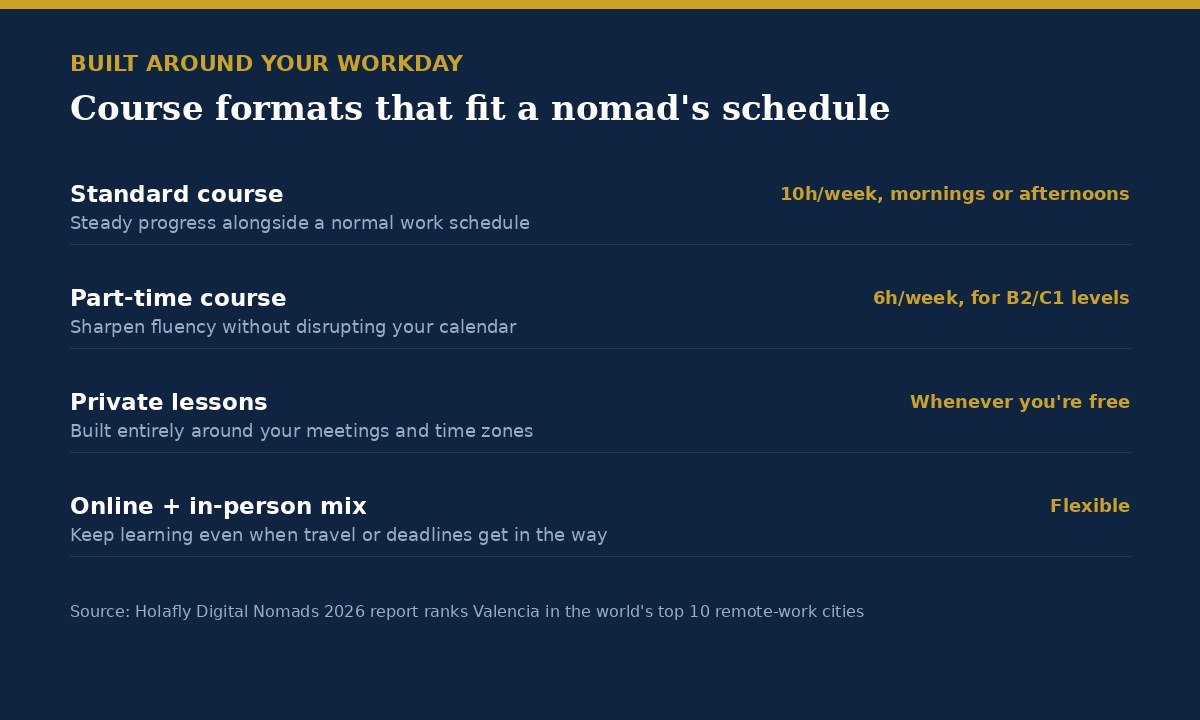
Morning or afternoon blocks a few times a week — enough structure to build real momentum, without swallowing your whole workday. The most popular choice for nomads staying a month or more.
If you already have decent Spanish and just want to sharpen it — better verbs, real idioms, the confidence to stop switching to English the moment a conversation gets interesting — this is a light enough touch to sit comfortably alongside a full work schedule.
Built entirely around you: early mornings before your first call, evenings after you close the laptop, or a single focused hour squeezed between meetings. The most flexible option for anyone whose schedule genuinely doesn't have a fixed shape.
Travel a lot, or have weeks where deadlines eat everything? A hybrid approach keeps your progress going even when in-person classes aren't realistic that week, so a rough patch doesn't undo a month of momentum.
Tell us your schedule, not the other way around
Share your work hours, time zone and goals, and we'll match you with a course format and teacher that actually fits your life in Valencia — free, no obligation.
Get a schedule-friendly recommendation →The Ruzafa effect: learning where you already work
If you're working from a coworking space in Valencia, there's a good chance you're already in or near Ruzafa — the neighborhood that's become the unofficial headquarters of the city's remote-work scene, packed with cafés, galleries and spaces like Wayco Ruzafa, well known locally for its weekly community events and terrace full of laptops. Learning Spanish here isn't an abstract classroom exercise; it's immediately testable three doors down from wherever you just had your lesson.
That proximity compounds fast. You learn a phrase in class on Tuesday, use it ordering lunch on Wednesday, get corrected kindly by a barista on Thursday, and by the following week it's just yours. Nomads consistently make faster progress than the numbers alone would predict, precisely because the neighborhood does half the teaching for you. Some even find their people through it — the informal "Coworking & Coffee" meetups that circulate around Ruzafa are exactly the kind of place a shaky new phrase gets its first real test.
What's realistic in 4, 8 and 12 weeks
Nomad life runs on realistic expectations, so here's an honest version, not a marketing one:
| Time in Valencia | With ~4-6h/week |
|---|---|
| 4 weeks | Ordering, small talk, understanding the gist of most everyday exchanges |
| 8 weeks | Real short conversations — with your barber, your neighbor, your landlord |
| 12 weeks | Comfortable in daily life, following group conversations without translating in your head |
Faster if you go higher on weekly hours, obviously — the math is the same as for anyone else studying Spanish in Valencia. What's different for nomads is that you're already living the immersion side for free: every WhatsApp group, every coworking small talk, every trip to the market is unpaid practice most short-term students don't get. That's a real advantage — use it.
Do you need a visa to be here?
Most digital nomads in Valencia are here on a Digital Nomad Visa or simply within their 90-day visa-free allowance, working for employers or clients based outside Spain — Spanish classes don't change that picture, and you don't need a student visa just to take a course. A short course, a standard course, private lessons: none of it requires anything beyond showing up and paying.
The one case worth a moment's thought: if your stay stretches on and studying Spanish becomes a bigger part of your plan than the odd evening class — or if you're weighing your longer-term legal options in Spain more broadly — it's worth understanding how the different visa routes actually compare. We cover that honestly, income thresholds and all, in our guide to how to move to Spain legally.
How to choose without overcommitting
The biggest mistake nomads make isn't picking the wrong course — it's picking too much course. Signing up for daily morning classes in week one, missing half of them by week three once deadlines pile up, and quietly giving up by week five. Here's a saner approach:
- Start smaller than you think you need. A part-time or standard course you'll actually attend beats an intensive one you'll skip.
- Match the format to your actual calendar, not your aspirational one. If your mornings are unpredictable, don't book mornings.
- Extend once it's working. It's far easier to add hours once you've built a habit than to recover from an overambitious start.
- Use the city as homework. The best exercises aren't in a textbook — they're the next coffee order, the next landlord message, the next coworking small talk.
Learn Spanish on your terms, not a syllabus
Tell us how long you're in Valencia and how your workdays actually look. We'll recommend a course that fits around your life — free and with no obligation.
Start learning →Frequently asked questions
Can I learn Spanish in Valencia while working remote full-time?
Yes. Standard courses (around 10 hours a week), part-time courses (around 6 hours), and private lessons are all designed to fit around a full remote work schedule, unlike the 20-hour intensive format aimed at short-stay students.
Do I need a student visa to take Spanish classes as a digital nomad?
No. Taking a Spanish course doesn't require a student visa — most digital nomads are already in Spain on a Digital Nomad Visa or within their 90-day allowance, and classes don't change that status.
What's the best neighborhood in Valencia to combine coworking and Spanish classes?
Ruzafa is the most popular choice — it's the city's unofficial remote-work hub, with a dense cluster of coworking spaces, cafés and an active international community, making it easy to practise immediately after class.
How fast can I realistically learn Spanish part-time?
With around 4-6 hours a week, most people reach comfortable daily conversation within about 8-12 weeks, especially when combined with the immersion that comes naturally from living and working in Valencia.
Can I do private lessons instead of a group course?
Yes, and many nomads prefer it — private lessons can be scheduled entirely around your meetings and time zone, which a fixed group class can't offer.
What if my schedule is unpredictable because of deadlines or travel?
A hybrid of online and in-person lessons keeps your progress going even during unpredictable weeks, so you don't lose momentum when work gets intense.
Is Valencia actually good for remote work?
Yes — it ranked in the world's top 10 cities for remote work in the 2026 Holafly Digital Nomads report, thanks to its climate, cost of living, connectivity and growing international community.
Will learning Spanish actually change my day-to-day life in Valencia?
Significantly. Even basic conversational Spanish changes how locals treat you — shopkeepers stop switching to English, landlords communicate directly, and you start feeling part of the neighborhood rather than passing through it.
Should I book an intensive course instead?
Only if you have the free mornings for it. If you're working full-time remotely, a standard or part-time course you'll actually attend consistently will get you further than an intensive one you end up skipping.
Can I start with a short trial and add more later?
Yes, and it's usually the smarter approach — start with a smaller commitment, see how it fits your real schedule, and extend once the habit is working.
Ready to actually live in Valencia, not just work from it?
Fill in the form and we'll match you with a Spanish course that fits your remote work schedule — free and with no obligation.
Get started →