
How Many Weeks of Spanish Do I Need?
It's the question everyone asks right before they book — and almost nobody answers clearly. The honest answer is: it depends entirely on what you actually need Spanish for. Here's a straight, goal-by-goal breakdown so you can book the right amount of time, not just a guess.
Key takeaways
- 1–2 weeks gives you travel basics; 3–4 weeks makes you a confident traveller.
- 6–8 weeks gets you to a solid A2 with real conversations; 12 weeks reaches working fluency (B1).
- 6 months or more aligns with the long-term student visa threshold and reaches B1–B2.
- The honest driver isn't the calendar — it's hours of class plus daily immersion. More of both means fewer weeks needed.
"How long should I study Spanish?" sounds like a simple question, but it's really three questions hiding inside one: how much Spanish do I actually need for my goal, how fast do I personally learn, and how many hours a week am I willing to commit? Get honest answers to those three and the number of weeks practically calculates itself.
This guide gives you a clear starting point — a goal-by-goal breakdown you can match to your own situation — plus the reasoning behind it, so you're not just picking a number out of the air.
What this guide covers
The real math behind "how many weeks"
Language schools measure progress in CEFR levels (A1 through C1), and each level takes roughly 60 hours of guided classes to reach, according to the standard used by the Instituto Cervantes. An intensive course runs about 20 hours a week, so on paper, one level takes around three weeks of class time.
In practice it's rarely that clean — everyone learns at a different pace, and some levels (especially B1 to B2) take longer than others because the material gets more nuanced. But the 60-hour benchmark is still the most useful planning tool you have: multiply it by your weekly hours, and you get a realistic number of weeks for the level you're aiming at.
| CEFR level | Approx. cumulative hours | Weeks on an intensive course (~20h/week) |
|---|---|---|
| A1 | 60 | ~3 weeks |
| A2 | 120 | ~6 weeks |
| B1 | 240 | ~12 weeks |
| B2 | 360 | ~18 weeks |
| C1 | 540 | ~27 weeks |
These are guided-class hours, starting from zero at each level. If you already speak some Spanish, you skip straight to the weeks for the level above yours.
Match your goal to a duration
Hours are useful, but most people don't think in CEFR levels — they think in trips, moves and life plans. Here's the same math translated into real goals.
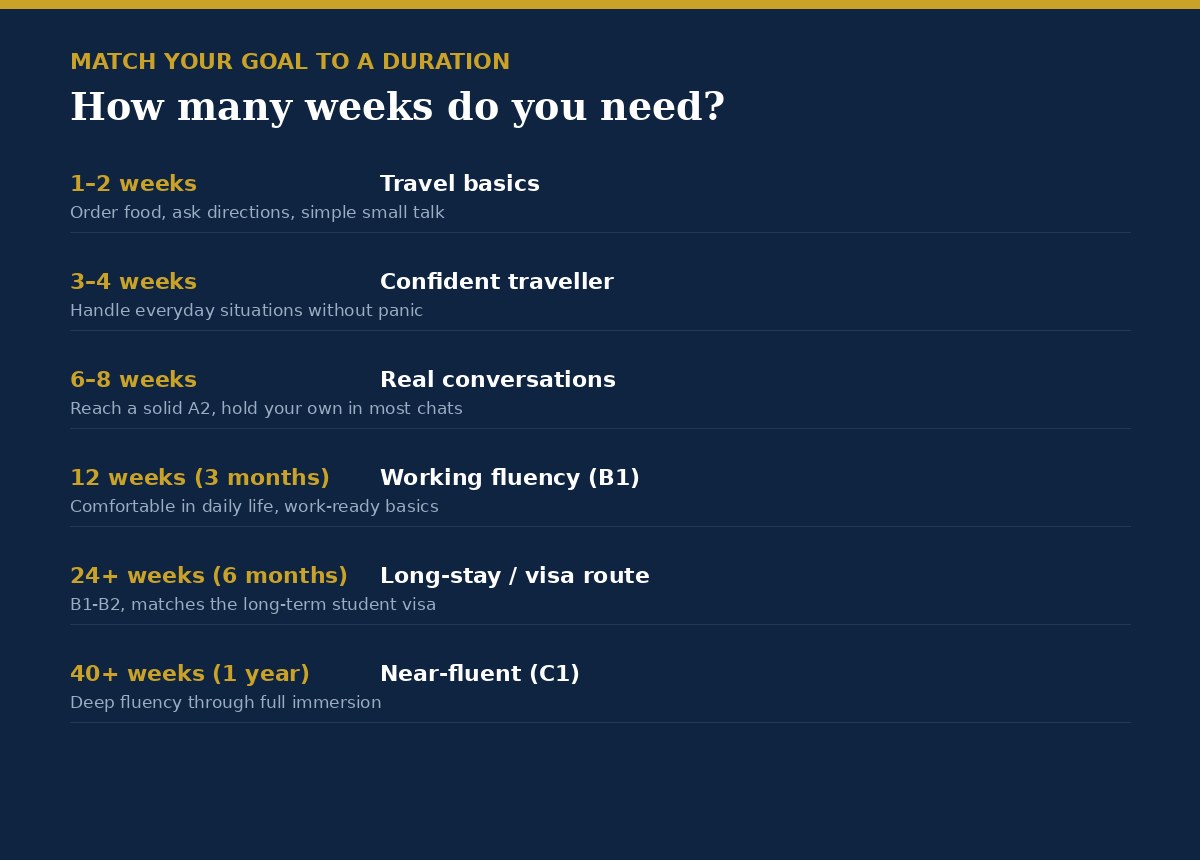
Enough to learn travel basics: greetings, ordering food, asking directions, simple small talk. You won't hold a real conversation yet, but you'll stop feeling helpless — and you'll enjoy the trip more because you're actually engaging with the place.
This is where things start to click. You can handle everyday situations without panicking — checking into a hotel, dealing with a problem, chatting briefly with locals. It's the sweet spot for a longer holiday or a "test the waters" trip before a bigger move.
Around here you reach a solid A2, sometimes edging into B1 with good immersion. You can hold actual conversations, not just transactions — this is the point where Spanish starts to feel like a skill you have, not a phrasebook you're reading from.
Three months of intensive study typically lands you at a strong B1. You're comfortable in daily life, can work through misunderstandings in Spanish rather than switching to English, and start being genuinely useful in work or study contexts.
Six months or more pushes you into B1–B2 territory and, not coincidentally, is also the point where Spain's student visa rules shift — see the section below. This is the range for people relocating, studying seriously, or building genuinely durable fluency.
A full year of study and immersion is what it typically takes to reach C1 — deep, nuanced fluency. Few people need this for casual reasons; it's the range for career moves, academic study, or simply falling in love with the language and the place.
Not sure which range fits you?
Tell us your goal and your available time and we'll recommend the right course length and level in Valencia — free, no obligation.
Get a free recommendation →Why immersion changes the math
Every number above assumes classroom hours alone. Add immersion — actually living where Spanish is spoken — and the same number of weeks gets you further, because you're practising far beyond your scheduled hours. Ordering coffee, chatting with a flatmate, arguing about football: none of that counts as "class," but all of it counts toward fluency.
This is the single biggest reason studying in Spain beats studying at home for the same number of weeks. A student doing an intensive course in Valencia and living there will typically outpace someone doing the identical course hours once a week back home — not because the lessons are different, but because one of them is surrounded by the language 24/7 and the other isn't.
Weeks, months, and the student visa threshold
If you're not from the EU, there's a hard number worth knowing before you pick a duration: 90 days. Stay 90 days or less and you generally don't need a student visa at all. Cross it, and you do — and once you're past 180 days, the visa becomes a full one-year authorization with its own extra requirements.
This means your answer to "how many weeks do I need" can also be an answer to "do I need a visa." A two-month trip (roughly 8–9 weeks) stays comfortably visa-free. A six-month program crosses into long-term visa territory — which is a bigger commitment, but also the range that gets you real fluency. If a longer stay is on the table, our complete Spanish student visa guide and our Valencia-specific visa guide walk through exactly what changes at that threshold.
How to actually decide what to book
Put it all together and the decision comes down to three honest questions:
- What do I actually need Spanish for? A holiday needs less than a relocation. Be specific, not aspirational.
- How many hours a week can I realistically commit? An intensive course (20h/week) moves faster than a standard course (10h/week) — match the format to your actual availability and intensity preference.
- Does my timeline cross the 90-day visa line? If it does, build the visa process into your planning from day one, not as an afterthought.
One more honest note: you can almost always extend once you're there. Many students book a shorter first block, see how they're progressing and how much they're enjoying it, then add more weeks on the ground. Booking the minimum you're confident about, with the option to extend, is often smarter than over-committing upfront.
Common planning mistakes
- Booking too short for the goal. Two weeks won't make you conversational — it's a great start, not a finish line. Match the duration to what you said you actually wanted above.
- Ignoring the visa threshold. Booking 12–14 weeks without checking whether that requires a visa can derail the whole trip.
- Choosing low weekly hours for a short stay. If you only have three weeks, a standard (10h/week) course wastes your limited time — go intensive.
- Assuming class hours alone will get you there. Without practising outside class, even a long course underperforms its potential. Immersion is not optional if speed matters to you.
Frequently asked questions
How many weeks of Spanish do I need to travel comfortably?
One to two weeks covers travel basics like ordering, directions and greetings. Three to four weeks makes you a genuinely confident traveller who can handle everyday situations.
How many weeks does it take to hold a real conversation in Spanish?
Around six to eight weeks of intensive study typically gets you to a solid A2, where real conversations become possible, not just transactional exchanges.
How many weeks for working fluency?
About twelve weeks (three months) of intensive study usually reaches a strong B1 — comfortable daily use and functional in work or study settings.
How many hours make up one CEFR level?
Roughly 60 guided class hours per level, based on the standard used by the Instituto Cervantes, though this varies by individual and by level.
Does living in Spain change how many weeks I need?
Yes, significantly. Immersion means you're practising far beyond your scheduled class hours, so the same number of weeks typically gets you further than the identical course taken at home.
How many weeks before I need a student visa?
If you're a non-EU citizen, stays of 90 days or less generally don't require a student visa. Beyond that, you'll need one, and beyond 180 days it becomes a full one-year authorization.
Is an intensive or standard course better for a short stay?
For a short stay, intensive (around 20 hours a week) makes better use of limited time than a standard course (around 10 hours a week).
Can I extend my course once I'm there?
Yes, in most cases. Many students book a shorter initial block and extend once they see their progress — often smarter than over-committing before arriving.
How many weeks do I need to reach fluency?
Reaching a near-fluent C1 level typically takes around a year of combined study and immersion, though "fluency" itself is often reached earlier at a strong B2, around 18 weeks of intensive study.
What if I already speak some Spanish?
Start from your current level rather than zero — take a placement test and count the weeks needed only for the levels above where you already are.
Ready to book the right number of weeks?
Fill in the form and we'll help you choose the ideal course length and school in Valencia for your goal — free and with no obligation.
Get started →